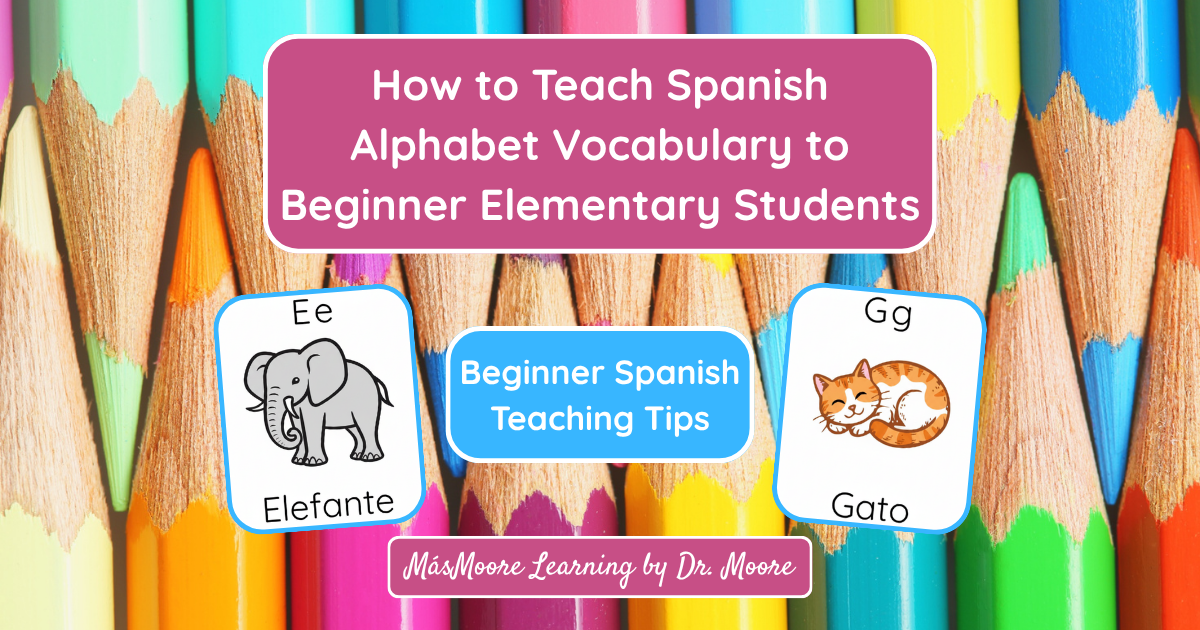
Spanish alphabet vocabulary gives beginner learners a simple way to connect letters, sounds, words, and pictures. When students learn Spanish alphabet vocabulary, they are not only practicing letter recognition. They are beginning to connect written language, spoken language, and visual meaning.
For young learners working around the Novice Low to Novice Mid range, or beginning learners who are developing familiar words, practiced phrases, and simple supported responses, the goal is not simply for students to memorize letter names. The goal is for students to recognize familiar Spanish letters, connect them to meaningful vocabulary, and begin using simple words and visuals to build early language confidence.
A practical learning goal for this lesson might be:
Students can recognize Spanish letters, connect selected letters to familiar Spanish vocabulary words, and identify or name matching visuals with support.
A Note for Teachers
I included English meanings in parentheses the first time key Spanish words or prompts appear. These are included for teacher planning, clarification, and support. During instruction, aim to use Spanish as much as possible while making meaning clear through visuals, gestures, modeling, songs, repeated routines, and picture support.
Start with Meaning, Not Just Letter Names
When teaching the Spanish alphabet, it can be tempting to begin by having students repeat the alphabet from beginning to end. Repetition has value, but beginner learners need more than letter recitation. They need to see the letter, hear the letter, connect it to a word, and understand that the word has meaning.
For example, students may connect:
• A with avión (airplane)
• B with bebé (baby)
• C with casa (house)
• D with dado (dice)
• E with elefante (elephant)
This kind of picture-word connection gives students a stronger foundation than memorizing isolated letters alone. It helps them understand that letters are connected to words, words are connected to meaning, and Spanish is a language they can begin to recognize and use.
Teach the Alphabet in Small, Manageable Parts
The Spanish alphabet includes 27 letters, including ñ. Students may also see letter combinations such as ch and ll in Spanish words, but those can be taught as letter combinations rather than separate letters of the alphabet. That can feel like a lot for young learners, especially if they are new to Spanish. Instead of introducing every letter, word, sound, and picture at once, consider teaching the alphabet in smaller sections.
A simple sequence may look like this:
• Introduce a small group of letters.
• Show each letter clearly.
• Say the letter and model pronunciation.
• Connect the letter to a Spanish vocabulary word.
• Show a matching picture.
• Have students repeat the letter and word.
• Review with a quick matching, tracing, coloring, or movement activity.
For example:
Teacher: A.
Students: A.
Teacher: A de avión.
Students: A de avión.
Teacher: ¿Dónde está el avión? (Where is the airplane?)
Students point to the picture.
This keeps the lesson active, visual, and developmentally appropriate.
Include Ñ as an Important Spanish-Specific Letter
One of the most important parts of teaching the Spanish alphabet is helping students notice that Spanish includes the letter ñ. This gives students an opportunity to understand that Spanish has its own sound-symbol patterns and is not simply English with different words.
Students may see ñ in words such as:
• ñandú (rhea, a large South American bird)
• niño (boy)
• niña (girl)
• piñata (piñata)
• año (year)
For beginner elementary learners, the goal is not for every ñ example to begin with ñ. The goal is to help students notice the letter, hear the sound, and recognize that ñ is an important Spanish letter.
You might say:
This letter is ñ. It has a special sound in Spanish. We can hear it at the beginning of ñandú and inside words like niño, niña, piñata, and año.
This builds language awareness in a simple, age-appropriate way.
Use Visuals to Build Vocabulary Recognition
Visuals are essential when teaching Spanish alphabet vocabulary. Young learners need concrete support as they connect letters and words to meaning. A picture gives students something to see, point to, match, color, or describe.
For example, when students see the letter M, the word mano (hand), and a picture of a hand, they can begin making connections between print, sound, and meaning.
Students can practice by:
• Matching uppercase letters to lowercase letters
• Matching Spanish words to pictures
• Identifying the first letter in a Spanish word
• Pointing to a picture after hearing the word
• Coloring a picture connected to a Spanish letter
• Tracing the letter and word
• Playing alphabet vocabulary bingo
• Completing a picture-word matching activity
These activities support early interpretive skills because students are looking at letters, words, and visuals and connecting them to meaning.
Support Pronunciation with Repetition and Audio
Spanish alphabet instruction should include listening. Students need repeated opportunities to hear Spanish letter names and vocabulary words pronounced clearly.
This is especially important because some Spanish letters and sounds may be different from what students expect in English. For example, Spanish vowels are more consistent than English vowels, and students may need repeated practice hearing letters and sounds such as j, h, r, and ñ.
For beginner learners, pronunciation practice should be clear, short, and encouraging. A simple routine may include:
• Listen
• Repeat
• Point
• Match
• Say it again
• Use it in a short phrase
For example:
Teacher: Escucha: casa. (Listen: house.)
Students listen.
Teacher: Repite: casa. (Repeat: house.)
Students repeat.
Teacher: C de casa.
Students: C de casa.
Recorded audio can also provide a consistent pronunciation model when needed, which may be useful across classroom instruction, homeschool settings, sub plans, and support staff contexts.
Add Tracing and Writing Practice with Purpose
Tracing and writing can be valuable when they are used intentionally. For young learners, tracing supports fine motor development, letter formation, print awareness, and vocabulary recognition. It also gives students time to slow down and notice the letter and word.
However, tracing should not be the entire lesson. It works best after students have already seen, heard, and practiced the letter and vocabulary word orally and visually.
A strong sequence might be:
• Show the letter and picture.
• Say the letter and word.
• Have students repeat.
• Ask students to point to or identify the picture.
• Then have students trace the letter and word.
• Finally, students can color, match, or write the word with support.
This keeps writing connected to meaning instead of becoming isolated handwriting practice.
Use Songs, Chants, and Movement
Songs and chants can support memory, rhythm, pronunciation, and engagement. Many elementary students enjoy hearing and repeating language through music, especially when the routine is predictable.
A Spanish alphabet song or chant can be used as a warm-up, transition, or review activity. Movement can also make alphabet practice more engaging.
Students might:
• Clap the syllables in a vocabulary word.
• Stand when they hear a specific letter.
• Point to the matching letter card.
• Walk to a letter posted around the room.
• Hold up a picture card when they hear the matching word.
• Trace a letter in the air while saying the letter name.
Movement helps students stay engaged while giving them another way to process the language.
Make Review Interactive
Alphabet vocabulary should be reviewed in multiple ways. Young learners need repeated exposure across several activities before the language becomes familiar.
Helpful review activities include:
• Alphabet Bingo: Students listen for letters or vocabulary words and cover the matching space.
• Picture-Word Matching: Students match Spanish words to visuals.
• Flashcard Review: Students identify letters, words, or pictures.
• Coloring Pages: Students connect letters and vocabulary to meaningful visuals.
• Word Search: Students recognize familiar Spanish alphabet words in print.
• Partner Practice: Students point, ask, answer, or name familiar letters and words.
• Quick Checks: Students circle, match, or identify the correct letter or picture.
The goal is not to rush students through the alphabet. The goal is to give them repeated, meaningful practice so they can recognize and use familiar language with confidence.
Support ACTFL-Informed Practice
Spanish alphabet vocabulary can support ACTFL-informed beginner language practice, particularly within the Communication goal area. Alphabet practice is strongest when it is connected to meaning and used as a bridge toward understanding, responding, and using familiar language in simple ways.
At the novice level, students benefit from activities that help them recognize familiar letters and words, connect language to visual meaning, and begin using practiced words or phrases in simple, supported ways.
For beginner alphabet instruction, this may look like:
• Interpretive Communication: Students recognize Spanish letters, vocabulary words, and visuals.
• Interpersonal Communication (extension): Students participate in simple exchanges using familiar letters, words, or picture prompts.
• Presentational Communication (extension): Students name a letter, identify a picture, or use a practiced phrase to share a familiar word.
For example, students might hear the word avión and point to the matching picture. They might ask a partner, ¿Qué letra es esta? (What letter is this?) or respond with Es la letra A. (It is the letter A.) They might also share a simple phrase such as A de avión.
At the novice level, these activities should remain clear, visual, repetitive, and supportive. Students are not expected to create complex language. They are learning to recognize, respond, and begin using familiar language in simple ways.
Use Simple Speaking Frames
Speaking frames help students move from recognition to supported language use. These frames should be simple, repetitive, and connected to visuals.
Helpful beginner frames may include:
• Esta es la letra ____. (This is the letter ____.)
• ____ de ____. (____ for ____.)
• Yo veo ____. (I see ____.)
• Mi palabra es ____. (My word is ____.)
• La palabra empieza con ____. (The word starts with ____.)
For very young learners, keep the frames even simpler:
• A de avión.
• B de bebé.
• C de casa.
These short frames give students a safe way to participate without requiring more language than they are ready to produce.
Add a Simple Partner Exchange
After students have practiced with teacher support, they can begin using the language with a partner. Partner practice should be short, structured, and highly supported.
A simple exchange might sound like this:
Student A: ¿Qué letra es esta? (What letter is this?)
Student B: Es la letra M. (It is the letter M.)
Student A: ¿Qué palabra empieza con M? (What word begins with M?)
Student B: Mano. (Hand.)
For younger students, simplify it:
Student A: M.
Student B: Mano.
The goal is not perfect conversation. The goal is for students to listen, respond, and interact with familiar language.
Spanish Alphabet Vocabulary Activities for Elementary Students
Once students have been introduced to the letters and vocabulary words, teachers can use short activities to support review and application.
Here are a few simple ideas:
• Letter Hunt: Students look for a specific Spanish letter around the room and connect it to a familiar word or picture.
• Listen and Point: The teacher says a letter or word, and students point to the matching card.
• Picture Match: Students match Spanish vocabulary words to visuals.
• Trace and Say: Students trace a letter while saying the letter and a connected Spanish word.
• Alphabet Bingo: Students listen for letters or vocabulary words and cover the matching letter or picture.
• Coloring Response: Students color a picture connected to a Spanish alphabet word or teacher prompt.
• Partner Cards: Students show a card and ask, ¿Qué letra es esta?
• Quick Check: Students circle the letter, word, or picture that matches the teacher prompt.
These activities help students revisit Spanish alphabet vocabulary in ways that are visual, active, meaningful, and appropriate for beginner learners.
Free Spanish Alphabet Resource
To help students review Spanish alphabet vocabulary, I created a free Spanish alphabet word search for beginner learners.
This free resource gives students a simple way to recognize familiar Spanish alphabet words in print while supporting vocabulary review, early reading practice, and independent work.
It can be used for centers, early finishers, sub plans, homeschool instruction, review, or informal practice.
Download the free Spanish Alphabet Word Search here.

Connect Alphabet Vocabulary to Classroom-Ready Resources
Spanish alphabet instruction becomes more effective when students have multiple ways to practice the same language. A strong alphabet sequence may include visual introduction, listening practice, tracing, matching, coloring, games, and review.
For example, teachers may introduce letters and vocabulary with flashcards or posters, reinforce recognition through coloring pages, support writing with tracing worksheets, review with bingo, and check understanding with picture-word matching or a word search.
This gives students repeated exposure without making every activity feel the same.
Additional Teaching Support
For teachers who would like classroom-ready support for Spanish alphabet vocabulary, MásMoore Learning by Dr. Moore offers beginner-friendly alphabet resources designed for elementary learners.
These resources can be used alongside the strategies in this post to support letter recognition, Spanish vocabulary recognition, picture-word connections, tracing, coloring, listening review, matching practice, centers, small groups, sub plans, homeschool instruction, early finishers, and informal review.
Final Thought
The Spanish alphabet is more than a beginning vocabulary list. It is an opportunity to help young learners connect letters, sounds, words, and visuals in meaningful ways.
When teachers use clear visuals, repeated listening, tracing, games, songs, movement, and simple speaking frames, students can begin developing confidence with Spanish alphabet vocabulary in a way that is structured, engaging, and developmentally appropriate.
The goal is not to rush students through all 27 letters in one lesson. The goal is to help students build a strong foundation so they can recognize familiar Spanish letters and words, connect them to visual meaning, and begin using simple language with support.
Frequently Asked Questions About Spanish Alphabet Vocabulary
What is Spanish alphabet vocabulary?
Spanish alphabet vocabulary connects Spanish letters with familiar words and pictures so beginner learners can recognize letters, sounds, and meaning together.
How do I teach Spanish alphabet vocabulary to beginners?
To teach Spanish alphabet vocabulary to beginners, use clear visuals, repeated listening, tracing, matching, coloring, songs, movement, and simple picture-word activities.
What are easy Spanish alphabet vocabulary activities?
Easy activities include alphabet bingo, picture-word matching, flashcards, tracing pages, coloring pages, word searches, letter hunts, and partner cards.
Why is Spanish alphabet vocabulary helpful for elementary learners?
Spanish alphabet vocabulary is helpful because it connects letters to familiar words and pictures, giving students a clear way to recognize Spanish in print and connect language to meaning.
Written by Dr. Moore
Dr. Moore, creator of MásMoore Learning by Dr. Moore, develops beginner Spanish teaching ideas and resources designed for elementary learners and ACTFL-informed classroom practice.
Enjoy beginner Spanish teaching tips? Subscribe to receive new MásMoore Learning blog posts and elementary Spanish resource updates.
Leave a Reply