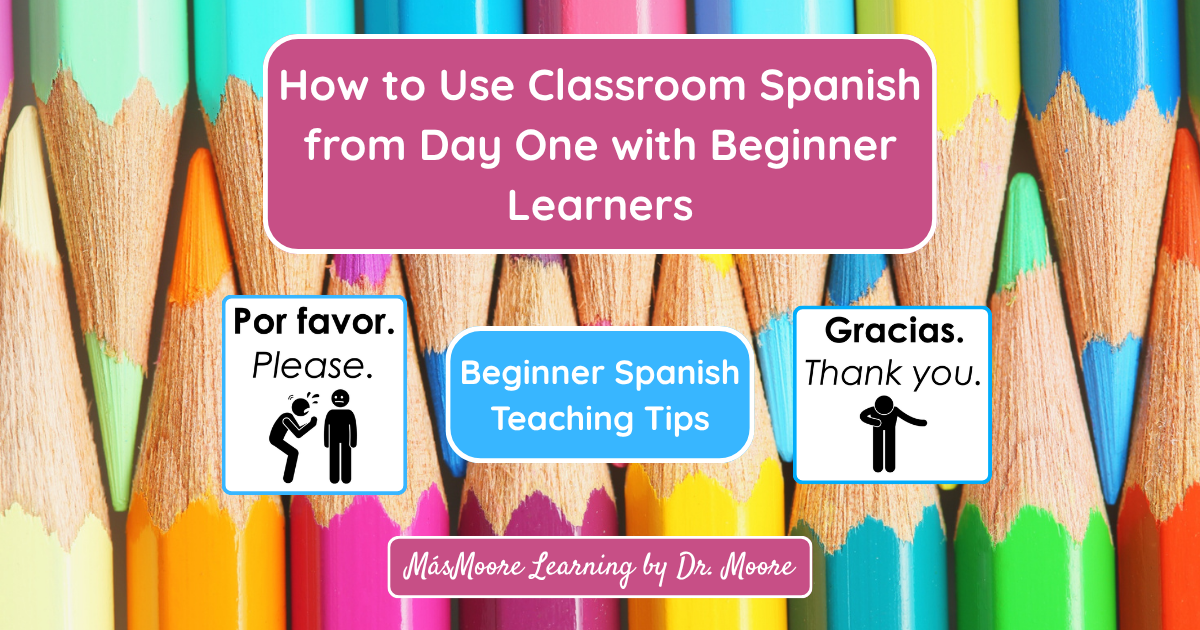
If you are wondering how to use classroom Spanish with beginner learners, start with short phrases, visuals, gestures, and everyday routines. Classroom Spanish is one of the most practical ways to help beginner learners experience Spanish as a real language used for communication. From the first days of instruction, students can begin hearing, recognizing, and using simple Spanish phrases for classroom routines, polite interactions, directions, materials, and basic needs.
For young learners working around the Novice Low to Novice Mid range, or beginning learners who are developing familiar words, practiced phrases, and simple supported responses, the goal is not for students to understand every word immediately. The goal is to help students connect classroom Spanish to clear actions, visuals, gestures, routines, and repeated opportunities to respond with support.
A practical classroom goal for using these phrases might be:
Students can understand familiar classroom Spanish phrases, respond to common teacher directions, and use simple support phrases during everyday classroom routines.
A Note for Teachers
I included English meanings in parentheses the first time key Spanish words or prompts appear. These are included for teacher planning, clarification, and support. During instruction, aim to use Spanish as much as possible while making meaning clear through visuals, gestures, modeling, repeated routines, and classroom context.
Start with Meaningful Classroom Routines
Classroom Spanish is most effective when it is connected to routines students already understand. Beginner learners need to hear Spanish in predictable moments so they can connect the language to meaning.
Instead of introducing classroom phrases as a long list, begin with the parts of class students experience regularly:
• listening
• looking
• reading
• writing
• repeating
• sitting down
• standing up
• getting materials
• passing papers
• asking for help
• asking for clarification
• using polite expressions
• responding to classroom directions
For example, students can begin with simple classroom phrases such as:
• Escucha. (Listen.)
• Mira. (Look.)
• Lee. (Read.)
• Escribe. (Write.)
• Repite. (Repeat.)
• Siéntate. (Sit down.)
• Ponte de pie. (Stand up.)
• Gracias. (Thank you.)
When classroom Spanish is tied to real routines, students are more likely to understand it, remember it, and use it with confidence.
Teach Classroom Spanish in Small, Usable Sets
Beginner learners can feel overwhelmed when too many phrases are introduced at once. A better approach is to introduce classroom Spanish in small, usable sets.
For example, during the first week, teachers might focus on a few high-frequency classroom directions:
• Escucha. (Listen.)
• Mira. (Look.)
• Repite. (Repeat.)
• Siéntate. (Sit down.)
Once students recognize those phrases, teachers can add more language gradually:
• Lee. (Read.)
• Escribe. (Write.)
• Ponte de pie. (Stand up.)
• Silencio. (Silence. / Quiet.)
Teachers can also introduce a small set of student support phrases:
• Necesito ayuda. (I need help.)
• No entiendo. (I do not understand.)
• ¿Puede repetir, por favor? (Could you repeat, please?)
This gradual approach helps students build confidence without feeling pressured to use too much language too quickly.
Use Visuals to Support Comprehension
Visual support is especially important for beginner elementary learners. When students see a picture, symbol, gesture, or classroom object connected to a Spanish phrase, they have a concrete reference point for meaning.
For example, a card that says Escucha with a listening visual can help students understand the direction without needing a full English explanation. A card that says Siéntate with a sitting visual can help students connect the Spanish phrase to the action.
Visuals can support students as they:
• recognize classroom phrases
• follow simple directions
• connect Spanish words to actions
• participate in routines
• ask for help
• understand classroom expectations
The goal is not to decorate the room with Spanish words. The goal is to make the language visible, meaningful, and usable.
Make the Word Wall an Active Communication Tool
A Spanish classroom communication word wall should be more than a passive display. It is most helpful when students and teachers use it during real classroom moments.
The word wall itself is not the goal of instruction. It is a scaffold that helps students access language they can use to understand, respond, ask for help, and participate in classroom routines.
A word wall can support beginner learners when it gives students language they can actually use. This may include phrases for asking questions, responding to directions, naming classroom materials, using polite expressions, and participating in routines.
For example, a student who does not remember how to ask for help can look at the word wall and use:
Necesito ayuda. (I need help.)
A student who needs clarification can use:
No entiendo. (I do not understand.)
A student who needs the teacher to repeat can use:
¿Puede repetir, por favor? (Could you repeat, please?)
When the word wall is used actively, it becomes a classroom communication support instead of a vocabulary poster students rarely notice.
Model, Practice, and Reuse the Same Phrases
Classroom Spanish becomes more meaningful when students hear the same phrases repeatedly in real classroom situations. Repetition should feel purposeful, not random.
A simple routine might look like this:
Teacher: Escucha. (Listen.)
Students listen.
Teacher: Mira. (Look.)
Students look.
Teacher: Repite. (Repeat.)
Students repeat.
Teacher: Siéntate. (Sit down.)
Students sit down.
This kind of repeated modeling helps students understand what the phrases mean and when to use them.
Teachers can also use gestures consistently. For example:
• point to your ear for Escucha
• point toward the board or card for Mira
• use a repeat gesture for Repite
• model sitting for Siéntate
• model standing for Ponte de pie
• point to the word wall when students need support
The more consistent the routine, the more confident students become.
Support Target-Language Use Without Overwhelming Students
ACTFL’s target-language guidance encourages teachers and learners to use the target language for the vast majority of instructional time, while also making language understandable through support such as visuals, gestures, routines, modeling, and checks for comprehension.
For beginner elementary learners, this does not mean giving long explanations in Spanish that students cannot follow. It means using Spanish in ways that are meaningful, supported, and understandable.
Teachers can support target-language use by using:
• visuals
• gestures
• modeling
• facial expressions
• pointing
• repeated routines
• comprehension checks
• classroom objects
• word wall support
For example, instead of giving a long explanation, a teacher might use short, familiar phrases:
Escucha. (Listen.)
Mira. (Look.)
Repite. (Repeat.)
These short phrases can become part of the classroom routine. Over time, students begin to recognize them and respond without needing translation each time.
This is one reason a classroom communication word wall can be helpful. It keeps important phrases visible so students have support as they listen, respond, and begin using Spanish during class.
Include Student Survival Phrases
Student survival phrases are important because they give beginner learners the language they need to participate more independently. These phrases help students ask for help, express confusion, make simple requests, and stay engaged during instruction.
Helpful student survival phrases may include:
• ¿Puedo ir al baño? (May I go to the bathroom?)
• ¿Puedo tomar agua? (May I drink water?)
• ¿Puedo tener un pañuelo? (May I have a tissue?)
• Necesito ayuda. (I need help.)
• No entiendo. (I do not understand.)
• ¿Puede repetir, por favor? (Could you repeat, please?)
These phrases help students participate in classroom life. They also reduce the pressure students may feel when they do not know what to say.
Use Polite Expressions and Social Language
Classroom communication is not only about commands and directions. Students also need polite expressions and social language that help build a positive classroom environment.
Beginner learners can practice phrases such as:
• Por favor. (Please.)
• Gracias. (Thank you.)
• ¿Qué tal? (How are you? / How’s it going?)
• ¿Cómo te llamas? (What’s your name?)
• ¿Dónde vives? (Where do you live?)
• ¿Cómo te sientes? (How do you feel?)
• ¡Salud! (Bless you! after a sneeze.)
These phrases are practical and can be used in natural classroom moments. They also help students understand that Spanish is used for real interaction, not only for vocabulary practice.
Use Classroom Objects and Materials
Classroom objects are another practical way to build meaningful language from day one. Students can connect Spanish words to objects they already see and use.
Common classroom words may include:
• el libro (the book)
• el papel (the paper)
• los papeles (the papers)
• la pizarra (the whiteboard / the chalkboard)
• el marcador (the marker)
• el borrador (the eraser)
• la puerta (the door)
• la alfombra (the rug / the carpet)
• la carpeta de argollas (the binder)
Teachers can use these words alongside classroom directions:
Saca tu libro. (Take out your book.)
Pasa tu papel. (Pass your paper.)
Borra la pizarra. (Erase the board.)
Abre la puerta. (Open the door.)
Cierra la puerta. (Close the door.)
These short phrases help students connect classroom materials and routines to language they can hear, see, and use.
Include Classroom People, Position Words, and Time Words Gradually
Classroom communication also includes the people, places, positions, and timing words students may hear during instruction. These words are helpful, but they do not need to be introduced all at once.
For people in the classroom, students may learn:
• la compañera (female classmate / partner)
• el compañero (male classmate / partner)
For position and direction words, students may learn:
• en frente de (in front of)
• detrás de (behind)
• arriba (up / above)
For time and classroom management, students may learn:
• minuto (minute)
• minutos (minutes)
• segundo (second)
• segundos (seconds)
For young learners, these words are easiest to understand when paired with visuals, movement, classroom objects, and repeated routines. The goal is to help students connect the words to clear meaning, not to memorize a list in isolation.
Allow for Regional and Classroom Preference
Spanish can vary by region, context, and classroom setting. Some words, phrases, and translations may have more than one acceptable form. Teachers may also have preferred expressions based on their own Spanish background, school setting, or student needs.
This is why classroom Spanish supports are most useful when they are clear, practical, and flexible. The goal is not to include every possible variation on one classroom display. The goal is to provide consistent, student-friendly language that supports communication, comprehension, and classroom routines.
When possible, editable resources can be helpful because teachers may adjust wording, translations, or regional preferences for their own classroom.
Support ACTFL-Informed Practice
Classroom Spanish can support ACTFL-informed beginner language practice, particularly within the Communication goal area. Classroom phrases are strongest when they are used as tools for meaning, participation, and interaction rather than as isolated vocabulary words or passive display items.
For beginner learners, classroom Spanish may support:
• Interpretive Communication: Students understand familiar classroom phrases, directions, and visual supports.
• Interpersonal Communication (extension): Students use simple phrases to ask for help, respond to the teacher, or interact with classmates.
• Presentational Communication (extension): Students use practiced classroom phrases, labels, or simple sentence frames to identify classroom items or share a familiar classroom response with support.
For example, students may hear Escucha and respond by listening. They may use Necesito ayuda to ask for help. They may identify el libro, el papel, or la puerta when supported by visuals and classroom context.
At the novice level, these activities should remain clear, visual, repetitive, and supportive. Students are not expected to use long or complex language. They are learning to understand familiar classroom language, respond appropriately, and begin using simple Spanish phrases in meaningful classroom situations.
How to Use Classroom Spanish in 7 Easy Beginner Routines
Classroom Spanish works best when it becomes part of regular routines. Here are a few simple ways to use classroom Spanish throughout instruction:
• Listen and Look Routine: Use Escucha and Mira with gestures and visuals.
• Repeat Routine: Use Repite when students practice a familiar word or phrase.
• Movement Routine: Use Siéntate and Ponte de pie with consistent gestures.
• Materials Routine: Use Saca tu libro, Pasa tu papel, or Borra la pizarra during classroom tasks.
• Student Help Routine: Teach students to say Necesito ayuda, No entiendo, or ¿Puede repetir, por favor? when they need support.
• Polite Phrase Practice: Encourage students to use por favor and gracias during classroom interactions.
• Quick Check: Say a classroom phrase and have students point, act it out, or choose the matching visual.
These routines help students use classroom Spanish in small, practical ways that build confidence over time.
Additional Teaching Support
By this point, you already have enough examples to begin building a simple classroom Spanish word wall with a few high-frequency phrases. Start small, choose phrases students will hear and use often, and add new language as classroom routines become familiar.
For teachers who would like a ready-to-use, organized set of classroom communication cards, MásMoore Learning by Dr. Moore offers a beginner-friendly Spanish Classroom Communication Word Wall designed for elementary learners.

This resource includes classroom phrases and vocabulary for polite expressions, student survival phrases, teacher directions, classroom commands, classroom objects, materials, people in the classroom, position words, direction words, time words, and classroom management language.
A classroom communication word wall can be especially helpful when it is introduced gradually and used consistently during instruction. Teachers can display all cards at once or begin with a small set of phrases and add more as students become familiar with the language.
For teachers who also want audio-supported vocabulary practice, the Spanish Classroom Vocabulary with Audio resource can pair well with a classroom communication word wall. The audio-supported resource can help students hear and practice classroom vocabulary, while the word wall keeps high-frequency classroom phrases and routines visible for everyday use. You can also browse more free beginner Spanish resources on my Free Resources page.

The goal is to give students language they can understand and use during real classroom routines.
Final Thought
Classroom Spanish is a powerful starting point for beginner learners because it helps students experience Spanish as part of everyday communication. Even simple phrases can become meaningful when they are connected to actions, visuals, routines, and repeated opportunities to respond.
A classroom communication word wall can support this process when it is used actively. It should not simply decorate the classroom. It should help students understand directions, ask for help, use polite expressions, name classroom materials, and participate with growing confidence.
The goal is not for students to master every phrase immediately. The goal is to help them build a practical foundation for understanding and using Spanish from day one.
Frequently Asked Questions About Classroom Spanish
What is classroom Spanish?
Classroom Spanish refers to simple Spanish phrases students hear and use during everyday classroom routines, directions, polite interactions, materials, and basic needs.
How do I use classroom Spanish with beginner learners?
To use classroom Spanish with beginner learners, start with a small set of short, practical phrases. Use visuals, gestures, modeling, and repeated routines so students can connect the Spanish phrases to clear classroom actions.
What classroom Spanish phrases should I teach first?
Start with high-frequency phrases students will hear often, such as Escucha, Mira, Repite, Siéntate, Ponte de pie, Gracias, Necesito ayuda, and No entiendo.
Why is a classroom Spanish word wall helpful?
A classroom Spanish word wall can help students see and use important phrases during real classroom moments. It works best when it is used actively for directions, questions, support phrases, polite expressions, and classroom routines.
Written by Dr. Moore
Dr. Moore, creator of MásMoore Learning by Dr. Moore, develops beginner Spanish teaching ideas and resources designed for elementary learners and ACTFL-informed classroom practice.
Enjoy beginner Spanish teaching tips? Subscribe to receive new MásMoore Learning blog posts and elementary Spanish resource updates.
Leave a Reply