MásMoore Learning by Dr. Moore

Tag: Spanish teaching tips

  • How to Use a Comprehensible Input Mini Story to Teach Spanish Greetings

    How to Use a Comprehensible Input Mini Story to Teach Spanish Greetings

    A comprehensible input mini story can help beginner Spanish learners understand greetings in context. Spanish greetings are often one of the first language topics introduced in beginner Spanish classes. Students may learn phrases such as Hola (Hello), Buenos días (Good morning), ¿Cómo estás? (How are you?), Estoy bien (I am fine / I am well), Más o menos (So-so), and Adiós (Goodbye).

    These greetings are practical and useful, but they can easily become isolated vocabulary words if students only repeat them from a list. Young learners need more than exposure to a phrase. They need context, visuals, repetition, gestures, and opportunities to show understanding in low-stress ways.

    That is where a comprehensible input mini story can be especially helpful.

    (more…)
  • How to Teach Spanish Alphabet Vocabulary to Beginner Elementary Students

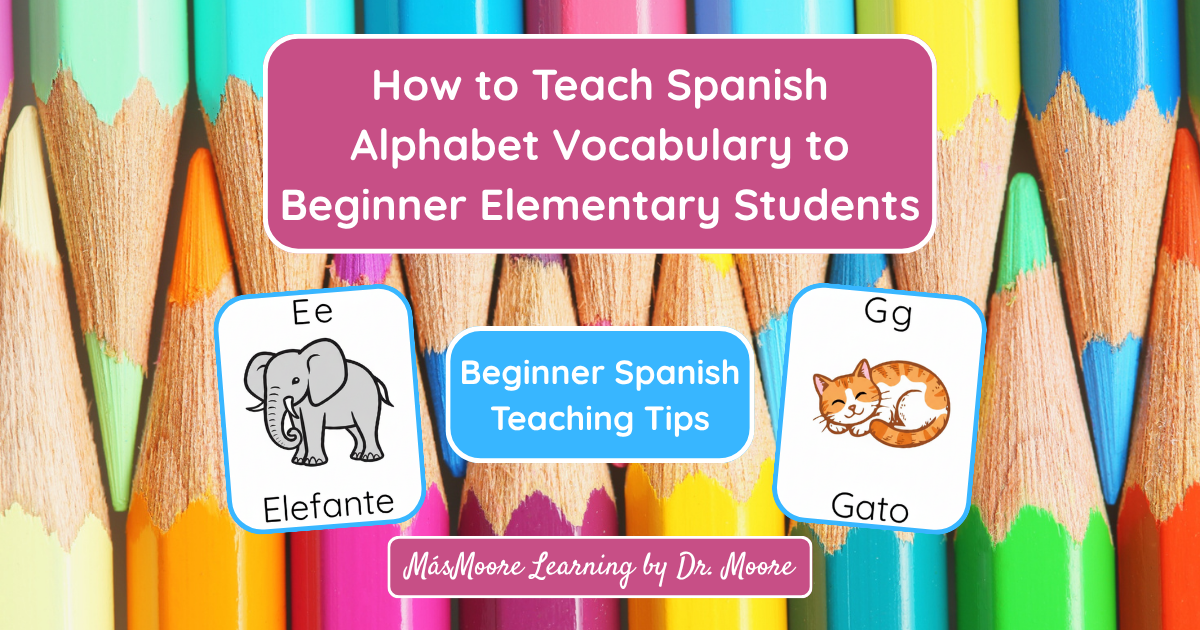
    How to Teach Spanish Alphabet Vocabulary to Beginner Elementary Students

    Spanish alphabet vocabulary gives beginner learners a simple way to connect letters, sounds, words, and pictures. When students learn Spanish alphabet vocabulary, they are not only practicing letter recognition. They are beginning to connect written language, spoken language, and visual meaning.

    For young learners working around the Novice Low to Novice Mid range, or beginning learners who are developing familiar words, practiced phrases, and simple supported responses, the goal is not simply for students to memorize letter names. The goal is for students to recognize familiar Spanish letters, connect them to meaningful vocabulary, and begin using simple words and visuals to build early language confidence.

    (more…)
  • How to Teach Spanish Colors to Beginner Elementary Students

    How to Teach Spanish Colors to Beginner Elementary Students

    If you are wondering how to teach Spanish colors to young learners, start with visuals, repetition, movement, and simple classroom routines. Spanish colors are a practical early topic for beginner elementary learners because color words are visual, familiar, and easy to connect to classroom objects, pictures, games, and simple oral language practice. When students learn words like rojo (red), azul (blue), amarillo (yellow), and verde (green), they are not only memorizing vocabulary. They are beginning to connect Spanish words to meaning in a way they can see, hear, and use.

    For young learners working around the Novice Low to Novice Mid range, or beginning learners who are developing familiar words, practiced phrases, and simple supported responses, the purpose is not just for students to know color words. The purpose is for students to understand familiar Spanish color words, respond to simple prompts, and begin using those words in clear, supported, and meaningful ways.

    (more…)